
1. Inductive Proximity Sensors: Working Principle & Applications
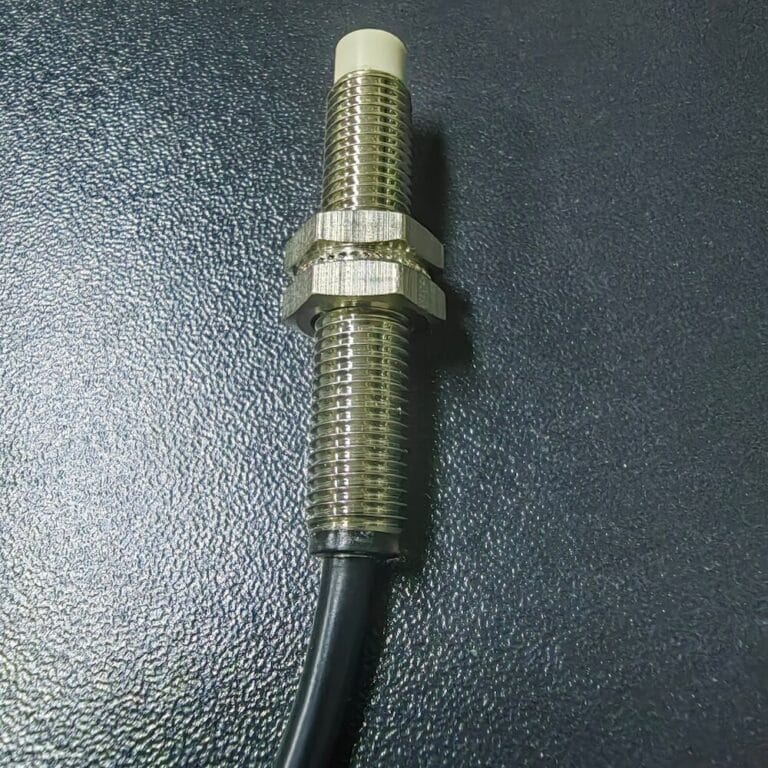
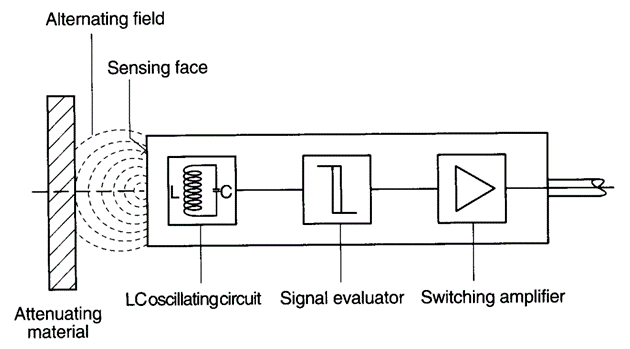
Inductive proximity sensors are non-contact position sensors that provide a digital switching output. At their core, they consist of an LC high-frequency oscillator and signal processing circuitry. The sensor generates an alternating electromagnetic field around its sensing face. When a metal target enters this field, eddy currents are induced within the target. These currents react back on the sensor, dampening the oscillator’s amplitude and altering the circuit’s internal parameters. The sensor detects this change, triggering its output state to switch. A key characteristic is that inductive sensors only detect metallic objects, making them ideal for metal presence detection in automation lines.
2. Capacitive Proximity Sensors: How They Work
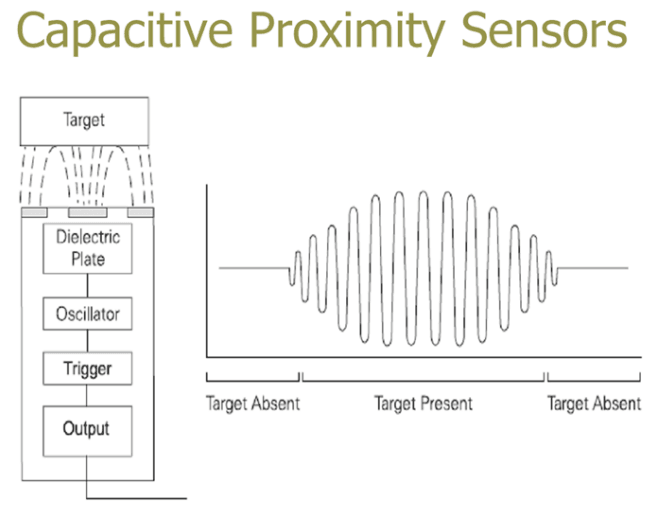
Capacitive proximity sensors are versatile position sensors with digital outputs, capable of detecting both conductive and non-conductive materials. The sensing head acts as one plate of a capacitor, while the target object forms the other. As an object approaches, the dielectric constant between the sensor and the target changes, altering the capacitance of the circuit. This change is detected by the sensor’s electronics, which then switches its output state. Unlike inductive sensors, they can detect metals, liquids, plastics, and powders. For materials with low dielectric constants, the sensor’s sensitivity can be adjusted via a multi-turn potentiometer, typically calibrated to trigger at 70-80% of the rated sensing distance.
3. Hall Effect Sensors: Operating Principle
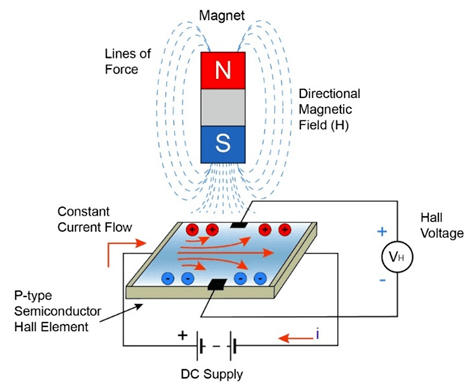
Hall effect sensors are active magnetic-to-electrical transducers built on the principle of the Hall effect. When a current-carrying semiconductor is placed perpendicular to a magnetic field, a measurable voltage difference (Hall voltage) develops across the material, proportional to the magnetic field strength. Hall sensors integrate this effect with signal conditioning circuitry to convert magnetic input into a stable digital output. Designed for industrial environments, they offer reliable performance, easy integration, and resistance to vibration and temperature fluctuations, making them ideal for contactless magnetic detection.
4. Magnetic Proximity Sensors: Working Principle & Advantages
Magnetic proximity sensors are non-contact switches that respond to permanent magnetic fields, offering longer sensing ranges than inductive sensors. Their operation depends on the direction of the magnetic target. As a magnet approaches, the permeability of the sensor’s core decreases, reducing the coil’s inductance and increasing its Q-factor. This boosts oscillator activity, raising the sensor’s current consumption and triggering the output switch. Key advantages over inductive sensors include:
- Can be embedded in metal enclosures
- No minimum spacing requirements for side-by-side installation
- The sensing face can be made of metal
- Can detect targets through non-ferrous metal barriers